
If you’re searching for honest Ecz Probiotic reviews or wondering whether the Aloha From Skin probiotic actually helps eczema — you’re probably tired of surface-level solutions.
Most people with eczema have already tried it all: steroid creams, elimination diets, antihistamines, “eczema-safe” skincare, random probiotics… only to see temporary relief before the next flare-up hits.
EczPro is different because it isn’t marketed as another skin product.
It’s positioned as a targeted probiotic designed specifically for people dealing with eczema and histamine sensitivity — based on the idea that eczema may not start on your skin at all, but in your gut.
So the real question is:
- Does that gut–histamine approach actually make sense?
- And more importantly — does EczPro work in real life?
In this in-depth review, we’ll break down:
- What EczPro is and how it works
- Why most probiotics don’t help eczema
- The gut–histamine connection explained
- The ingredients inside EczPro
- Real pros and cons
- Who it’s for (and who it’s not for)
By the end, you’ll know whether EczPro is worth trying — or just another supplement making big promises.
What Is EczPro by Aloha From Skin?
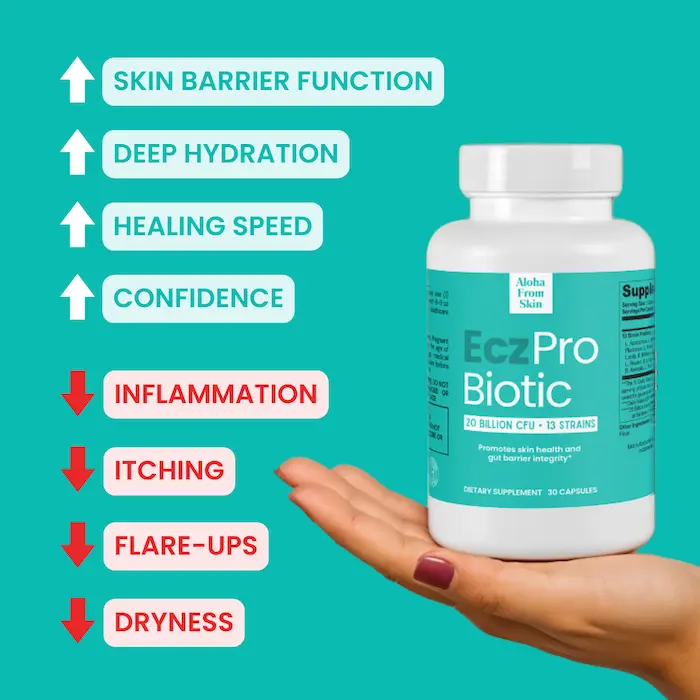
EczPro is a targeted probiotic supplement created by the brand Aloha From Skin, formulated specifically for individuals struggling with eczema, dry skin, and recurring inflammatory flare-ups.
Unlike most probiotics that are designed for general digestive health, EczPro is positioned as a gut-skin support formula.
According to the brand, the product focuses on restoring microbial balance in the gut using 13 carefully selected probiotic strains that are considered “histamine-safe.”
That distinction is important, because some common probiotic strains can actually increase histamine production — potentially worsening symptoms in people who are sensitive to it.
EczPro is marketed as:
- A probiotic designed with eczema in mind
- Free from common allergens like gluten, soy, and dairy
- Manufactured in a GMP-certified facility in the United States
- Focused on calming immune overactivation rather than masking symptoms
The core idea behind EczPro is simple:
If eczema is connected to immune dysregulation that begins in the gut, then improving gut balance may help reduce systemic inflammation — and in turn, reduce flare-ups on the skin.
But to understand whether that logic holds up, we first need to look at why most probiotics fail when it comes to eczema.
Why Most Probiotics Don’t Work for Eczema
If you’ve ever tried a random probiotic for your eczema and saw little to no improvement, you’re not alone.
The reason isn’t that probiotics “don’t work.”
It’s that most of them weren’t designed with eczema in mind.
Here’s where things get interesting.
Eczema isn’t just a skin issue.
It’s widely considered an immune-driven inflammatory condition. And over 70% of your immune system resides in your gut — specifically in the gut-associated lymphoid tissue (GALT).
When your gut microbiome is balanced, your immune system stays regulated.
But when the microbiome becomes disrupted — due to antibiotics, stress, infections, diet, environmental toxins, or chronic inflammation — the immune system can remain in a low-grade state of overactivation.
And that overactivation doesn’t stay in the gut.
It shows up systemically.
For some people, it appears as digestive discomfort.
For others, it shows up on the skin — as redness, itching, flaking, or unpredictable flare-ups.
The Histamine Problem Most People Miss

One of the most overlooked mechanisms in eczema is histamine regulation.
Histamine is a natural compound involved in immune response. It plays a role in inflammation, itching, and allergic reactions.
Under normal circumstances, your body breaks down excess histamine using an enzyme called DAO (diamine oxidase), much of which is active in the gut.
But research suggests that some individuals with eczema may have:
- Lower DAO activity
- Reduced levels of histamine-degrading bacteria
- Higher levels of histamine-producing microbes
When histamine isn’t properly cleared, it can accumulate — leading to symptoms that feel like allergies, even when allergy tests are negative.
That might explain why some people experience:
- Redness after certain foods
- Random flare-ups without obvious triggers
- Itching that seems disproportionate
- Temporary improvement from antihistamines
And here’s the key issue:
Many generic probiotics contain strains that actually produce histamine.
So while someone may think they’re “supporting their gut,” they may unintentionally worsen histamine load — making eczema symptoms harder to control.
That’s one reason broad-spectrum digestive probiotics often fail to make a meaningful difference in eczema.
Surface Treatments vs Root Drivers
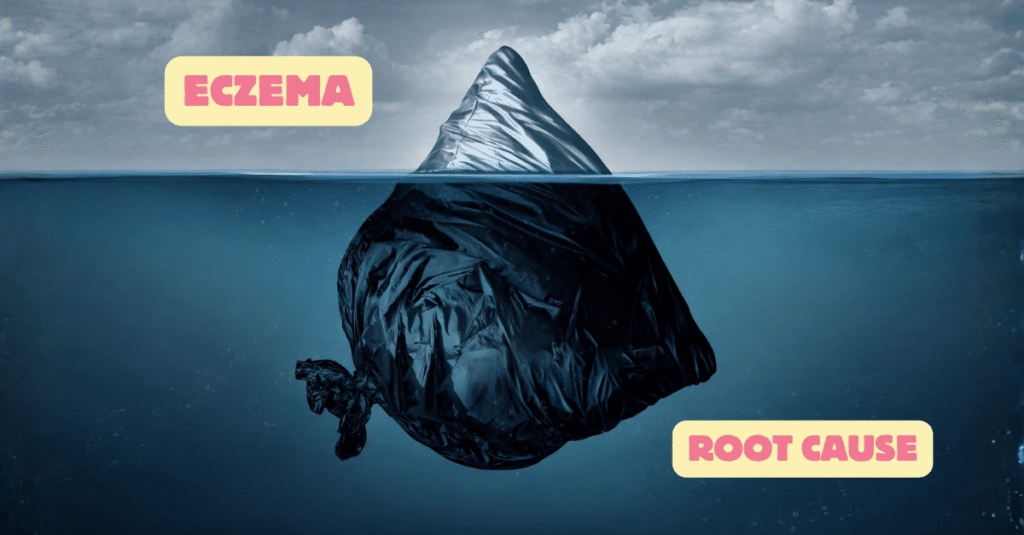
Most eczema treatments focus on calming visible inflammation:
- Steroid creams
- Topical immunosuppressants
- Barrier creams
- Moisturizers
And while they can provide temporary relief, they don’t address immune signaling or gut microbiome imbalance.
So the cycle continues:
Calm the flare → symptoms fade → flare returns.
This is the gap EczPro claims to target.
Instead of focusing on the skin directly, it focuses on restoring microbial balance and supporting histamine regulation at the gut level — with strains selected specifically for immune tolerance rather than general digestion.
But what exactly makes EczPro different from other probiotics?
That’s what we’ll look at next.
The Gut–Histamine Approach Behind EczPro
EczPro is built around one central idea:
Eczema may persist not because the skin is damaged — but because the immune system remains overstimulated from within.
Instead of targeting symptoms on the surface, the formula focuses on restoring balance at the gut level — particularly in relation to microbial diversity and histamine regulation.
Here are the five core mechanisms EczPro claims to support — and what they actually mean in practical terms.
1. Supporting Gut Barrier Integrity
One theory often discussed in immune-related skin conditions is increased intestinal permeability — commonly referred to as “leaky gut.”
When the gut lining becomes compromised, partially digested food particles, bacterial fragments, and inflammatory compounds may pass into the bloodstream more easily.
This can trigger immune responses that don’t shut off properly.
In people predisposed to eczema, that immune activation may manifest on the skin.
EczPro contains probiotic strains selected to support:
- Beneficial bacterial growth
- Short-chain fatty acid production
- Gut lining integrity
- Microbial balance restoration
By improving gut ecosystem stability, the goal is to reduce background immune stimulation — which may, over time, result in fewer inflammatory flare-ups.
2. Reducing Histamine Burden

Histamine overload is increasingly discussed in connection with eczema-like symptoms.
Some individuals experience:
- Flushing
- Itchiness
- Redness after food
- Sensitivity without confirmed allergies
One explanation is impaired histamine breakdown.
Unlike many broad-spectrum probiotics, EczPro is formulated with strains described as “histamine-safe” — meaning they are not known to produce histamine and may support its natural degradation.
If histamine levels decrease, the downstream inflammatory signaling may also calm.
For someone whose eczema is driven partly by histamine dysregulation, this mechanism makes theoretical sense.
3. Calming Immune Overactivation
Eczema involves an overreactive immune response — often skewed toward inflammatory signaling pathways.
A balanced microbiome plays a key role in immune tolerance.
Certain probiotic strains are associated with:
- Supporting regulatory T-cell activity
- Promoting anti-inflammatory signaling
- Helping immune system recalibration
Rather than suppressing immunity (like steroids), the idea here is modulation — helping the immune system react appropriately instead of excessively.
That difference matters long term.
4. Supporting the Skin Barrier From Within

While EczPro doesn’t act topically, gut health and skin barrier function are increasingly linked.
A healthier gut may improve:
- Nutrient absorption
- Fatty acid metabolism
- Systemic inflammation levels
All of which influence skin hydration, elasticity, and resilience.
When internal inflammation decreases, the skin may have more capacity to repair itself naturally.
This is often described as supporting the “gut–skin axis.”
5. Long-Term Flare Control vs Temporary Relief
Perhaps the most important distinction is this:
Most eczema solutions are reactive.
EczPro is positioned as preventative.
Instead of calming a flare after it appears, the goal is to reduce the internal triggers that drive recurrence in the first place.
That doesn’t mean it works overnight.
Because microbiome shifts take time.
But for people whose eczema has been resistant to topical-only approaches, addressing the gut–immune connection may offer a different angle.
At this point, the theory behind EczPro sounds compelling.
But theory and real-world results aren’t always the same thing.
So the next logical question is:
What’s actually inside EczPro — and do the ingredients support these claims?
EczPro Ingredients Breakdown
EczPro is formulated as a skin-directed probiotic blend containing 13 strains and 20 billion CFU per serving.
Instead of focusing purely on digestive comfort, the formulation centers around strains that have been studied in relation to immune balance, inflammation regulation, and the gut–skin axis.
Here’s a closer look at what’s inside.
Full Strain List (13 Total)
The formula includes:
- Lactobacillus acidophilus
- Lactobacillus salivarius
- Lactobacillus plantarum
- Lactobacillus rhamnosus
- Bifidobacterium lactis
- Bifidobacterium bifidum
- Lactobacillus fermentum
- Lactobacillus reuteri
- Bifidobacterium longum
- Lactobacillus gasseri
- Bifidobacterium animalis
- Lactobacillus paracasei
- Bifidobacterium breve
Additional ingredients:
- Brown rice flour
- Vegetable cellulose capsule
The formula is:
- Allergen-free (no lactose, soy, gluten, or dairy)
- Non-GMO
- Free from artificial fillers or unnecessary additives
Why These Strains Matter for Eczema
What makes this blend more targeted than a generic probiotic is the strain selection.
Several of these strains — particularly L. rhamnosus, L. plantarum, L. paracasei, B. longum, and B. breve — have been studied in the context of:
- Immune modulation
- Reduction of inflammatory signaling
- Skin barrier support
- Atopic dermatitis research models
For example:
- Lactobacillus rhamnosus has been examined in multiple clinical settings related to eczema and immune tolerance.
- Bifidobacterium longum is associated with supporting gut barrier integrity and calming inflammatory responses.
- Lactobacillus plantarum is often studied for its ability to support intestinal lining strength and microbial balance.
While that doesn’t automatically guarantee clinical results for every user, the strain choices are not random.
They align with mechanisms discussed in gut–skin axis research.
20 Billion CFU — Is That Enough?
EczPro provides 20 billion CFU per serving.
This is considered a moderate-to-strong daily dose — not extreme, but clinically relevant.
More importantly, effectiveness depends on:
- Strain functionality
- Survivability through digestion
- Long-term consistency
Higher CFU counts do not necessarily equal better outcomes if strain selection isn’t targeted.
In this case, the emphasis appears to be on quality and immune-relevant strains rather than inflated numbers.
Overall, from a formulation standpoint, EczPro appears intentionally designed around immune balance and gut-skin signaling rather than generic digestive support.
But formulation theory is only one side of the equation.
The next important question is:
What are real people actually experiencing when they take it?
What Real Ecz Probiotic Reviews Say (Pros & Complaints)
When people search for EczPro reviews, they’re usually looking for one thing:
Does it actually help real eczema symptoms — or is it just another supplement?
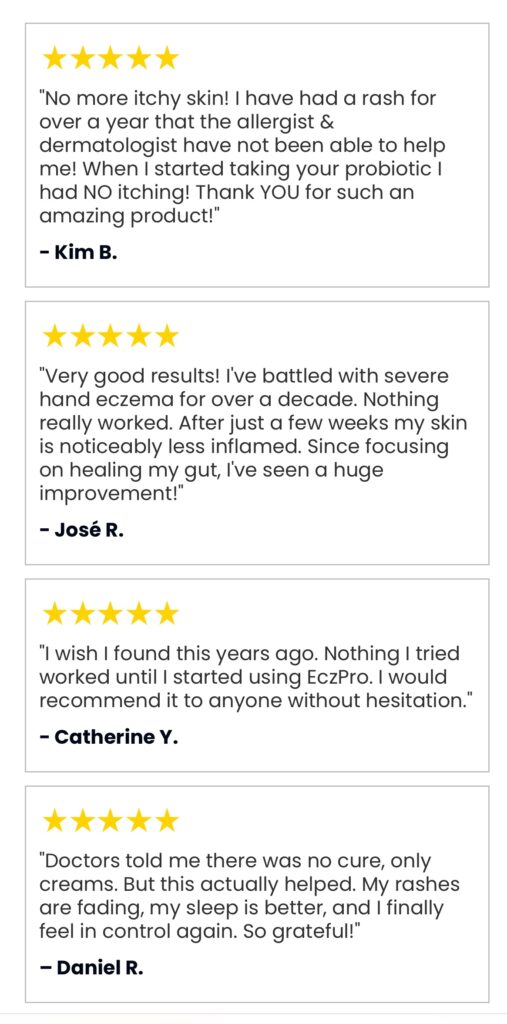
Based on customer feedback across the brand’s website and user discussions, experiences tend to fall into a few common patterns.
What People Like About Ecz Probiotic
1. Reduced Itching and Redness
Many users report that the first noticeable improvement isn’t visual — it’s a reduction in itch intensity.
For some, itching becomes:
- Less constant
- Less aggressive at night
- Easier to manage without antihistamines
Since histamine is closely linked to itching, this aligns with the product’s proposed mechanism.
2. Fewer Flare-Ups Over Time
Another common theme is gradual improvement rather than instant transformation.
Users who report positive outcomes often mention:
- Flares becoming less frequent
- Flares resolving faster
- Skin not reacting as strongly to minor triggers
This suggests possible immune modulation rather than surface-level suppression.
3. Improved Digestion
Interestingly, some people notice digestive improvements before skin changes.
This can include:
- Reduced bloating
- More regular digestion
- Less post-meal discomfort
Because gut balance typically shifts before skin changes appear, this sequence makes physiological sense.
Common Complaints or Neutral Feedback
No supplement works for everyone — and EczPro is no exception.
Here are the most common concerns mentioned:
1. Takes Time to Work
Some users expect visible skin changes within days.
But microbiome modulation usually requires several weeks.
People who stopped after 1–2 weeks often reported little change.
Those who continued for 4–8 weeks were more likely to report noticeable improvements.
This timeline aligns with what we know about gut ecosystem adaptation.
2. Not a “Cure”
EczPro is not positioned as a medical treatment or cure for eczema.
Some users with severe atopic dermatitis still required:
- Topical treatments
- Trigger avoidance
- Medical supervision
It appears more effective as part of a broader gut-focused strategy rather than a standalone miracle solution.
3. Individual Variability
Eczema has multiple potential drivers:
- Allergic triggers
- Genetic barrier dysfunction
- Environmental irritants
- Hormonal changes
- Microbiome imbalance
If someone’s eczema is not strongly linked to gut dysbiosis or histamine sensitivity, results may be more subtle.
That variability is important to acknowledge.
Overall Pattern in Reviews
The general pattern among positive reviewers tends to be:
Week 1–2: Minimal visible change
Week 3–4: Reduced itching, improved digestion
Week 4–8: Gradual calming of flare frequency
That gradual curve is consistent with how probiotic-based immune modulation typically works.
But anecdotal feedback only goes so far.
To decide whether EczPro is worth trying, it helps to understand who is most likely to benefit — and who may not.
Let’s break that down next.
Who Should Try EczPro?
Ecz Probiotic isn’t designed as a universal eczema solution.
It’s positioned around a specific hypothesis:
That gut imbalance and histamine dysregulation may be contributing to chronic flare-ups.
With that in mind, certain people may be more likely to benefit than others.
You May Be a Good Candidate If:
1. Your Flare-Ups Feel “Allergy-Like” — But Tests Are Negative
If you experience:
- Redness after certain foods
- Random itching without clear contact triggers
- Symptoms that resemble allergies
- Improvement with antihistamines
but allergy testing hasn’t identified a clear cause, histamine regulation may be playing a role.
In those cases, a histamine-conscious probiotic approach could make sense.
2. You’ve Tried Creams But Flares Keep Returning
Topical steroids and barrier creams can reduce inflammation temporarily.
But if symptoms consistently return once you stop using them, it may suggest an internal driver rather than purely external irritation.
EczPro is aimed at addressing immune signaling upstream — not just calming surface symptoms.
3. You Also Experience Digestive Symptoms
People with eczema often report:
- Bloating
- Food sensitivities
- Irregular digestion
- Sensitivity to fermented foods
If skin and digestion seem connected in your case, the gut–skin axis may be relevant.
4. You Suspect Histamine Sensitivity
Common signs associated with histamine sensitivity include:
- Flushing
- Headaches after certain foods
- Itching without rash
- Sensitivity to aged or fermented foods
While histamine intolerance is complex and not always easy to diagnose, EczPro’s strain selection is designed with histamine considerations in mind.
Who Might Not See Major Results?
It’s equally important to define who may not benefit significantly.
EczPro may be less impactful if:
- Your eczema is primarily contact-driven (detergents, metals, fragrances)
- You have strong genetic barrier dysfunction unrelated to immune triggers
- You’re expecting overnight transformation
- You discontinue use after only a week or two
Probiotic-based immune modulation requires consistency and time.
Is EczPro a Replacement for Medical Treatment?
No.
It’s a dietary supplement — not a prescription medication.
People with severe atopic dermatitis, infected lesions, or systemic symptoms should remain under medical supervision.
EczPro appears best suited as:
- A complementary strategy
- A gut-focused layer of support
- A longer-term approach rather than a quick fix
At this point, you likely have a clearer idea of whether the mechanism aligns with your situation.
So now let’s answer the core question directly:
Is EczPro actually worth trying?
Pros and Cons of EczPro
No supplement is perfect — and EczPro is no exception.
Here’s a balanced breakdown based on formulation, mechanism, and user patterns.
✅ Pros
1. Targeted for Eczema (Not Just Digestion)
Most probiotics are marketed for bloating or general gut health.
EczPro is specifically formulated around:
- Immune modulation
- Histamine sensitivity
- Gut–skin signaling
That focus alone differentiates it from generic blends.
2. Thoughtful Strain Selection
The 13-strain combination includes species commonly studied in:
- Immune tolerance
- Skin inflammation
- Gut barrier support
Rather than chasing extremely high CFU numbers, the emphasis appears to be on strain relevance.
3. Histamine-Conscious Formula
This is one of the stronger strategic points.
Because histamine sensitivity is often overlooked in eczema discussions, using strains selected with that in mind may be beneficial for a subset of users.
4. Allergen-Free and Clean Label
- No lactose
- No soy
- No gluten
- No dairy
- Non-GMO
- No unnecessary additives
For people with eczema, minimizing irritant exposure matters — even in supplements.
5. Non-Steroidal Approach
Unlike topical steroids or immunosuppressants, EczPro doesn’t suppress immune response.
It aims to regulate it.
For people seeking a longer-term internal strategy, that may be appealing.
❌ Cons
1. Not an Overnight Fix
If someone expects dramatic skin clearing in 3–5 days, they will likely be disappointed.
Microbiome shifts take time — often 4–8 weeks or longer.
2. May Not Help All Types of Eczema
Eczema isn’t one single condition with one single cause.
If someone’s flares are:
- Primarily environmental
- Strongly genetic
- Purely contact-based
gut-focused strategies may only provide partial benefit.
3. Requires Consistency
Probiotics only work while you take them consistently.
Stopping early may prevent meaningful microbiome adaptation.
4. It’s Still a Supplement
It’s not FDA-approved as a treatment for eczema.
And it should not replace medical care in moderate to severe cases.
Overall, the strengths of EczPro lie in its targeted formulation and gut–immune focus.
The limitations lie mostly in expectations and individual variability.
So now let’s answer the big question directly.
Final Verdict: Is EczPro Worth It?
EczPro is not a miracle cure.
But it also isn’t just another random probiotic.
Its formulation reflects a growing understanding of the gut–skin axis and histamine regulation in inflammatory conditions.
If your eczema:
- Feels allergy-like without confirmed allergies
- Flares unpredictably
- Has not responded long-term to creams alone
- Seems connected to food or digestion
then a gut-focused approach like EczPro may be worth exploring.
On the other hand, if you’re looking for immediate, dramatic results within days — this likely isn’t that solution.
The most realistic expectation would be:
- Gradual improvement
- Reduced itch intensity
- Fewer or milder flare-ups over time
For people whose eczema has an internal inflammatory component, EczPro presents a biologically plausible strategy.
For others, results may vary.
Ultimately, whether it’s worth trying depends on whether the gut–immune hypothesis aligns with your experience.
FAQ About EczPro
Is EczPro legit?
Yes — EczPro is a real probiotic supplement sold directly through the official Aloha From Skin website.
According to the brand, it is:
- Manufactured in a GMP-certified facility in the United States
- Non-GMO
- Free from gluten, soy, dairy, and lactose
- Made with 13 probiotic strains and 20 billion CFU
It is not sold as a prescription treatment, but as a dietary supplement designed to support gut balance and immune health.
As with any supplement, individual results vary — but the product itself is a legitimate branded formulation.
How long does EczPro take to work?
EczPro is not designed to produce overnight results.
Because it works through microbiome modulation, most noticeable changes — if they occur — would typically appear after:
- 3–4 weeks (digestive improvements or reduced itch intensity)
- 4–8 weeks (more stable flare patterns)
The brand positions it as a long-term gut-support strategy rather than a short-term skin fix.
Consistency is important for probiotic-based approaches.
Is EczPro better than regular probiotics?
That depends on your goal.
Most general probiotics are formulated for:
- Digestive comfort
- Bloating
- Regularity
EczPro is positioned as a skin-directed probiotic with:
- 13 strains selected with immune balance in mind
- 20 billion CFU per serving
- Consideration for histamine sensitivity
If your concern is eczema specifically, a targeted formulation may be more relevant than a broad digestive probiotic.
Does EczPro help with histamine intolerance?
EczPro is marketed as using strains selected to be histamine-compatible.
Some probiotic strains can produce histamine, which may worsen symptoms in sensitive individuals.
EczPro’s formulation is designed to avoid commonly histamine-producing strains and support immune balance.
However, histamine intolerance is complex and not officially recognized as a single medical diagnosis in all clinical settings. Anyone with suspected histamine intolerance should consult a healthcare professional.
What are the ingredients in Ecz Probiotic?
EczPro contains 13 probiotic strains and 20 billion CFU:
- L. Acidophilus
- L. Salivarius
- L. Plantarum
- L. Rhamnosus
- B. Lactis
- B. Bifidum
- L. Fermentum
- L. Reuteri
- B. Longum
- L. Gasseri
- B. Animalis
- L. Paracasei
- B. Breve
Other ingredients:
- Brown rice flour
- Vegetable cellulose capsule
The formula is allergen-free and contains no lactose, soy, gluten, or dairy.
Is EczPro safe?
For generally healthy adults, probiotics are typically well tolerated.
Some individuals may experience mild digestive adjustment symptoms during the first few days, such as:
- Temporary bloating
- Changes in stool frequency
People who are immunocompromised, pregnant, or under medical supervision should consult their healthcare provider before starting any probiotic supplement.
Where can you buy EczPro?
EczPro is sold directly through the official Aloha From Skin website.
The brand often offers bundle pricing and occasional promotions.
Because it is sold direct-to-consumer, it may not be available on major marketplaces.